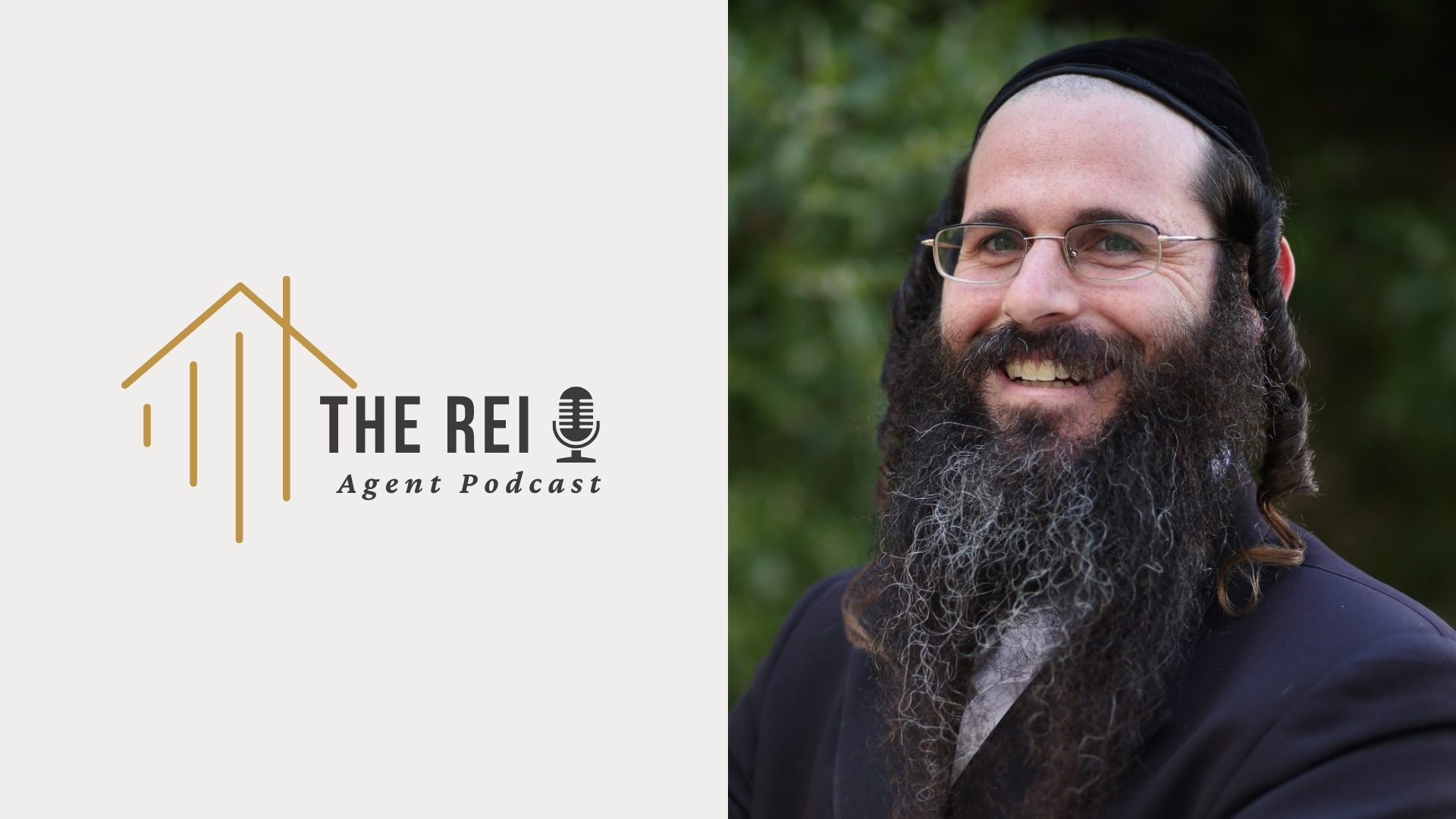
Turn Tax Knowledge Into Lasting Wealth Through Cost Segregation with Yonah Weiss
Key Takeaways
- Cost segregation can accelerate depreciation deductions, potentially allowing investors to keep significantly more capital working for them during the early years of property ownership.
- Investors can miss valuable tax opportunities when their CPA or financial team doesn't specialize in investment property taxation, making the right professional relationships critical.
- Long-term wealth isn't built through tax strategies alone. Yonah emphasizes networking, continuous learning, teaching others, and helping one person every day.
United States Real Estate Investor®
The REI Agent with Yonah Weiss
https://youtu.be/GmtyvmXcc4Y
United States Real Estate Investor®
Value-rich, The REI Agent podcast takes a holistic approach to life through real estate.
Hosted by Mattias Clymer, an agent and investor, alongside his wife Erica Clymer, a licensed therapist, the show features guests who strive to live bold and fulfilled lives through business and real estate investing.
You are personally invited to witness inspiring conversations with agents and investors who share their journeys, strategies, and wisdom.
Ready to level up and build the life you truly want?
Follow and subscribe to The REI Agent on social
Youtube
X-twitter
United States Real Estate Investor®


United States Real Estate Investor®
Cost Segregation is the Tax Strategy Too Many Investors Never Learn
For many investors, building wealth is only half the battle.
The other half is understanding how to keep more of what they earn.
On this episode of The REI Agent Podcast, Mattias Clymer sat down with Yonah Weiss, Business Director at Madison SPECS and one of the most recognizable educators in the cost segregation space, to explore an area that can completely change the way investors think about taxes, depreciation, and cash flow.
Yonah has been involved with thousands of cost segregation studies, but his real strength is education. He has built his career around taking complicated financial concepts and making them understandable to everyday investors.
That mission comes from experience. Before becoming deeply involved in property investing and tax strategy, Yonah was a teacher. When a serious family health crisis pushed his household deeper into debt, he realized something had to change.
"Going deeper into debt really was a wake-up moment for me."
That moment eventually sent him down a completely different professional path and opened the door to a world he knew almost nothing about.
Sometimes the Hardest Season Creates a New Direction
From Teaching to Commercial Property
Yonah did not grow up dreaming about mortgages, depreciation schedules, or investment properties. When financial pressure forced him to reconsider his career, he simply began talking to people around him about possible opportunities.
Those conversations kept pointing him toward property.
Then a chance meeting with a friend changed everything. The friend was involved in commercial mortgages and owned multifamily properties. Yonah admitted he knew nothing about either subject, but instead of allowing that lack of experience to stop him, he became an apprentice.
For months, he absorbed everything he could.
He later earned his property license and broker's license, participated in fix and flips, and continued building relationships throughout the industry. Eventually, networking led him to Madison SPECS.
What happened next revealed an enormous educational gap.
The 99 Percent Discovery
When Yonah began asking investors, agents, and lenders within his network about cost segregation, almost nobody knew what he was talking about.
That surprised him because the strategy could potentially create significant tax savings for property owners.
"What's stopping people from unlocking these incredible tax savings was literally just education."
Suddenly, his background as a teacher made perfect sense.
He had not left education behind. He had simply found a new classroom.
The $50,000 Investment That Produced a $66,000 Write-Off
Mattias Saw the Strategy Work Firsthand
Mattias brought the conversation out of theory by sharing his own investing experience.
He invested $50,000 as a limited partner in a mobile home park syndication. He was not managing the properties or running the operation. He was investing alongside experienced operators whom he trusted.
Then the tax documents arrived.
According to Mattias, his $50,000 investment generated approximately $66,000 in tax deductions during the first year.
The investment itself was still designed to produce returns and long-term ownership benefits. The tax savings were an additional advantage created through depreciation.
That experience provided the perfect setup for the most important question of the episode.
What exactly is cost segregation?
Depreciation Is Not What Many People Think
A Property Can Rise in Value While Creating a Tax Deduction
Yonah explained that understanding cost segregation begins with understanding depreciation.
In everyday conversation, depreciation usually means something is losing value. In tax terminology, depreciation works differently.
When someone buys an investment property, the tax code generally allows that owner to deduct portions of the property's depreciable value over time. Residential property typically follows a 27.5-year schedule, while commercial property generally follows a longer schedule.
The property does not have to actually lose market value for the owner to receive the deduction.
Yonah used a simplified example of a $1 million property that might create roughly $30,000 of annual depreciation after accounting for land.
That alone can be valuable.
Cost segregation attempts to accelerate part of those deductions.
How $30,000 Can Become $200,000 or $300,000
The Power of Accelerating Depreciation
A property is not just one giant asset. It contains many different components.
Yonah explained that certain elements may fall into shorter depreciation categories. Personal property can include items such as appliances, fixtures, flooring, cabinets, and other components that are not considered part of the core structure. Land improvements may fall into another category.
A cost segregation study identifies and separates those components.
Instead of depreciating everything according to the building's standard schedule, qualifying components can potentially be depreciated more quickly.
That is where the numbers can become dramatic.
Using Yonah's simplified $1 million property example, an investor might normally receive around a $30,000 annual deduction. Through cost segregation, however, the investor could potentially accelerate hundreds of thousands of dollars in deductions into the earlier years of ownership.
"Instead of a $30,000 deduction, I'm getting a $200,000 or $300,000 deduction."
"That's literally 10x."
This is why Yonah describes cost segregation as a cash flow mechanism.
The strategy does not magically create depreciation that never existed. It changes the timing of deductions that may already be available.
The Recapture Question That Scares Investors
Being Subject to Tax Is Not the Same as Paying It Immediately
Accelerating deductions naturally raises another question.
What happens when the property is sold?
Yonah explained depreciation recapture, a tax consideration that can arise when an owner sells a depreciated property.
The word "recapture" often makes investors assume they will simply have to repay every dollar of tax savings they previously received. Yonah emphasized that the issue is more nuanced than that.
"There's a big difference between being subject to a tax and paying a tax."
He discussed several strategies investors may explore with qualified professionals, including 1031 exchanges and opportunity zone investments, which may affect the timing or treatment of taxable events.
The broader lesson was simple. Investors should understand the entire life cycle of a strategy instead of making decisions based on one frightening financial term.
Your Financial Team Can Either Expand Your Options or Limit Them
Not Every CPA Specializes in Property Investing
One of the strongest themes of the episode had very little to do with calculations.
It was about people.
Mattias and Yonah discussed the importance of surrounding an investor with professionals who actually understand property investing.
An accountant can be excellent at accounting while still having limited experience with specialized property strategies.
Yonah said he regularly meets successful investors whose CPAs are unfamiliar with cost segregation.
That knowledge gap can become expensive.
His message was not that investors should blindly challenge their accountants. It was that they should make sure their professional team has experience that matches their financial goals.
If someone is building a serious investment portfolio, that person should have professionals who understand serious investment portfolios.
The Tax Advantage Agents May Be Overlooking
Real Estate Professional Status Changes the Conversation
The discussion became especially relevant for agents when Mattias brought up real estate professional status, often called REPS.
Yonah described it as one of the most powerful areas of the tax code available to qualifying property professionals.
He also warned listeners against oversimplified claims they may hear online.
"If you have a W-2, that's just not the case."
Yonah explained that qualifying as a real estate professional involves specific requirements. He discussed the importance of working primarily within the property business and meeting material participation requirements, including the 750-hour standard.
He also discussed short-term rentals as a separate area with different participation rules.
The larger point was powerful for agents.
Working in the industry may create opportunities that people outside the industry do not have, but those opportunities still have rules.
Understanding those rules can turn professional knowledge into an enormous financial advantage.
Opportunity Zones Turn Tax Incentives Into Community Investment
When Government Incentives and Investor Goals Meet
The conversation then moved into opportunity zones.
Yonah explained that the program came from the 2017 Tax Cuts and Jobs Act and was designed to encourage investment in designated communities throughout the country.
The concept connects tax incentives with redevelopment.
Rather than immediately paying certain capital gains taxes, investors may have opportunities to reinvest qualifying gains into opportunity zone projects and potentially receive tax benefits depending on how the investment is structured and held.
Yonah described it as a long-term strategy.
Mattias added an important perspective. The investment still needs to make sense as an investment. Ideally, the property creates value, produces cash flow, appreciates, or accomplishes the investor's broader financial goals.
The tax benefit should strengthen a good investment, not rescue a bad one.
Cost Segregation Is Not Only for Giant Properties
Smaller Investors May Have More Options Than They Realize
Near the end of the conversation, Yonah delivered a rapid series of cost segregation lessons.
One of the biggest misconceptions is that the strategy is only useful for enormous commercial properties.
Yonah said properties purchased for more than approximately $200,000 may often be worth evaluating for a study, depending on the circumstances.
He also explained that cost segregation does not necessarily have to be performed immediately after purchasing a property.
Investors who have owned a property for years may potentially use catch-up depreciation without amending every prior tax return, depending on their situation and professional guidance.
That means someone reading this today may already own an asset containing opportunities they never knew existed.
Do It Right or Risk Losing the Benefit
Yonah also warned against treating cost segregation like a casual spreadsheet exercise.
A legitimate cost segregation study involves detailed analysis and an engineering-based report.
He cautioned listeners about do-it-yourself approaches that may not withstand scrutiny during an audit.
The principle applies far beyond taxes.
When the stakes become significant, expertise matters.
Your Network Is Your Net Worth
The Most Valuable Advice Had Nothing to Do With Taxes
After an episode filled with tax strategies and financial concepts, Yonah shifted the conversation toward something even bigger.
Life.
He shared several principles that have guided his own success, starting with relationships.
"Your network is your net worth."
For Yonah, networking is not simply collecting contacts. It means intentionally surrounding oneself with forward-thinking people, people who inspire growth, and people whose lives reflect qualities worth pursuing.
The right relationships can introduce opportunities, knowledge, mentors, partners, and perspectives that would be nearly impossible to discover alone.
His own career is proof.
A conversation led to an apprenticeship. Networking led him deeper into the property industry. Another connection eventually led him to Madison SPECS.
The relationships came before many of the opportunities.
Stay Humble Enough to Keep Learning
Success Requires Remaining a Student
Yonah's second principle was humility.
Successful people cannot assume they have finished learning.
Markets change. Strategies change. Opportunities change. People grow.
The investor who remains curious can continue adapting while the person who believes they already know everything eventually becomes limited by their own confidence.
Yonah encouraged listeners to remain open to learning from unexpected people.
Someone does not need to be famous, wealthy, or highly credentialed to teach another person something valuable.
Sometimes growth begins when ego gets quiet enough to listen.
Teach What You Know and Give What You Can
Helping Others Can Become Its Own Form of Wealth
Yonah's third principle was teaching.
People frequently underestimate how much useful knowledge they already possess.
Someone may consider a skill ordinary simply because they have practiced it for years. To another person, that same knowledge could solve an enormous problem.
Yonah believes knowledge becomes more valuable when it is shared.
That philosophy extends beyond business.
He discussed the concept of giving not only money, but time.
People may believe they are too busy to contribute, but Yonah challenged that assumption. The question is often not whether time exists. The question is where helping others ranks among a person's priorities.
That idea led to one of the most memorable lessons of the episode.
"HOPE. Help one person every day."
The goal does not have to be changing the entire world.
It can be one phone call.
One introduction.
One piece of advice.
One person helped today.
Then another tomorrow.
Who Not How Can Change the Way a Business Grows
Stop Assuming Everything Has to Be Done Alone
When Mattias asked Yonah about books that had influenced him, Yonah mentioned Power Connector, which he was currently reading, and Who Not How, a book that significantly changed the way he approaches business and life.
The core idea resonated deeply with the conversation.
Instead of constantly asking how to accomplish everything personally, successful people can begin asking who may already possess the skills, enthusiasm, or experience to handle those responsibilities.
This allows people to focus more energy on the work they genuinely enjoy and do best.
Mattias added that tasks one person dislikes may actually be work another person enjoys.
Delegation does not have to mean dumping undesirable work onto someone else. It can mean placing people where their strengths naturally fit.
Knowledge Creates Options, but Action Creates Change
The Final Lesson From Yonah Weiss
This conversation ultimately became about much more than depreciation.
Yonah Weiss demonstrated how education can change financial outcomes, how relationships can redirect careers, and how difficult seasons can lead people toward opportunities they never expected.
His story began with financial pressure and uncertainty. It moved through teaching, mentorship, networking, property investing, and eventually a career built around helping other people understand strategies that many never learn.
The tax strategies discussed throughout the episode may help investors ask better questions of their accountants, advisors, and financial teams. But the deeper lesson is universal.
People cannot take advantage of opportunities they do not know exist.
That makes education one of the most powerful investments anyone can make.
Learn continuously. Build relationships intentionally. Surround yourself with capable professionals. Share what you know. Help someone every day.
And when new knowledge reveals a better path, have the courage to take it.
"You'll become a better person. You'll be happier. And I believe that's really the path to success."
Stay tuned for more inspiring stories on The REI Agent podcast, your go-to source for insights, inspiration, and strategies from top agents and investors who are living their best lives through real estate.
For more content and episodes, visit reiagent.com.
Articles Related to The REI Agent
- 10 Shocking Truths From the 2025 Global Housing Storm (And How Agents and Investors Can Thrive Through It)
- Shocking Balance Before Wealth (How Erica Clymer’s Holistic Practices Help Agents and Investors Thrive in Global Housing)
- Global Housing Storm (Holistic Solutions to Million-Dollar Dreams, Desperate Sellers, Rising Rents, and Shifting Wealth)
- Top 20 Terrifying Reasons Agents Will Never Be Investors (And How to Fix It)
- 10 Ways to Kill Real Estate Agent Burnout in 2025 (The Holistic Fix)
- Mattias Clymer is Silently Leading a $70M Movement That’s Changing Agent Lives
- Therapy You Didn’t Know You Needed (Holistic Wisdom for Real Estate Professionals)
- From For Sale Signs to Life Design (How The REI Agent Transforms Real Estate Into Holistic Wealth)
- Achieving Holistic Wealth and Success Through Real Estate (Insights from The REI Agent)
- Partnering with Investors (How Real Estate Agents Can Exponentially Maximize Profits)
United States Real Estate Investor®


United States Real Estate Investor®
Contact Yonah Weiss
United States Real Estate Investor®
Mentioned References
United States Real Estate Investor®
Transcript
Welcome back to the REI Agent. Today, my guest is Yonah Weiss, business director at Madison Specs and one of the most prolific educators in the cost segregation space. Yonah has been involved in more than 15,000 cost segregation studies, helping investors unlock over $3 billion in tax savings and has appeared as a guest on more than 300 real estate podcasts.
He has a rare gift for making complex tax strategy generally understandable. And today, we're going to use that gift to break down exactly how agent investors can legally and significantly reduce their tax bill through cost segregation. Yonah, welcome to the REI Agent podcast.
Thank you so much, Mattia. It's great to be here. And like you said in your intro, it's something hopefully we're going to be able to blow the minds of our listeners, agents out there to help unlock tax savings, which I think everyone who pays taxes knows that it's something you would love to reduce or get rid of if you can.
Yeah, yeah. And I don't think any of our audience really thinks this way, but I know that there's definitely people who look at saving money from taxes or when people do these kinds of things, it's like, oh, what are they doing? They're cheating the taxes.
But no, this is tax code written there. And anybody who files their taxes, they're going through and saying, yes, I have a dependency or yes, they're taking tax advantages of what the tax code says. This is just specific to real estate and even more specific to real estate designated professionals, which we can get into in more detail.
But I want to first ask you how you got into this space in general. We mentioned a little bit off air about some of your journeys in investing. So maybe we can start there and then dive into why anybody should care about cost segregations.
Absolutely. So I got involved in real estate about 10, 11 years ago. I was a teacher before that.
So my background isn't teaching and really it's still what I do today is education and really been my passion since I've been a young, like since I was a kid. I used to have tutor people and do all that kind of stuff. About 10, 11 years ago, I had some major health issue in my immediate family, some crisis and put us in the hole like big time.
I still had student debt, but this put us like way back. And as a teacher, I wasn't making too much money. So going deeper into debt really was a wake up moment for me.
And I realized I had to do something else, either get another job or find a different profession, something entirely. And putting it out there to acquaintances and friends of mine, real estate kept coming up in conversation. And so I realized, hey, why don't we try this out through what I describe as divine providence, just meeting a friend one day in the parking lot and telling him what I'm going through.
And he said, hey, why don't you come work with me? He was doing commercial mortgages, very successful real estate investor as well on his own. He owned a bunch of multifamily properties on his own and his family.
And I knew nothing about mortgages. I knew nothing about real estate. He took me under his wing.
I literally apprenticed him, as I call it, for about eight, nine months and learned everything there was to know, at least I thought at that time about commercial real estate. It was incredible, incredible experience. From that, I got my real estate agent license as well, broker's license.
And then I did a few fix and flips. Long story short, I ended up through various connections. And really that's one of the things we'll talk about a little bit later, but making connections and through networking.
I ended up meeting someone who worked for this company, Madison Specs, which now I work with, and they were looking to hire someone in business development. I didn't really know anything about Cosig at the time, but reached out to one of my mentors and asked him, hey, what do you know about this cost segregation thing? Really successful real estate developer, been doing it for 30 years.
He's like, oh yeah, we use Madison for all our costs. It's amazing. So I was like, okay, that tells me something.
But what I found was even more fascinating is when I started, I, again, didn't know anything about the topic, which hopefully we'll get into a little more. I reached out through my network that I had built over the past prior couple of years in the real estate world to all my contacts. Like, hey, you guys know what this Cosig thing, you have any properties, blah, blah, blah.
99% of the people I reached out to in the real estate space, whether investors, agents, lenders, you name it, 99% had no idea what Cosig was. And that blew my mind. And it was like a light bulb moment for me because I realized what's stopping people from unlocking these incredible tax savings with this tax strategy called Cosig was literally just education.
And I was like, hey, that's where I come in. It's perfect for me. This is going to work out really well.
So that's my transition in a nutshell of how I got into it.
I love it. And just to maybe set the stage a little bit for the personal story, I invested in my first deal, my first syndication deal. And for people who don't understand what that is, is basically I became a limited partner.
I had no say. I didn't run the business of this mobile home syndication. This is multiple mobile home parks.
But I trusted the operators. I thought it was a good opportunity. I liked the projection, the plan for the whole investment.
And so I invested $50,000 into it to get a feel for what this space was all about. And I actually only was an owner in it for a few months. And we got to write off $66,000 off our taxes- For investing $50,000.
For investing $50,000. And that's not what sold me on this deal. It was still a good deal where I was getting a preferred return on that $50,000.
And the plan was for that property to get to a point where they could refinance the money out back to me, and then I would still have ownership in this deal indefinitely. So the next year, I think we made $16,000 or $12,000 off of our taxes, where we were able to save that much. So not near as much, but still, we're up to $70,000 almost by now.
And so anyway, that's just a little foreshadow as to the power of what a cost seg is. And that's the vehicle that they did to get to this. So yeah, please take it from here.
Explain to people what the heck a cost seg is.
Yeah. Well, we'll take a step back because we have to understand what depreciation is first. And some of them may know what that is, but really it's just a borrowed term when it comes to real estate.
It doesn't actually mean your property is going down in value. It's the name of a tax deduction the IRS gives you when you buy a property besides for your primary residence. So it can be residential, commercial, single family, multifamily, or like you said, a mobile home park, office, you name it.
You're able to take this deduction called depreciation. And it's based solely on you as the buyer. So based on your purchase price, and when you bought it, you get to start what we call depreciating it.
And it's over a 27 and a half year time period. Basically we take the purchase price, we subtract a little bit for land, and then we divide the rest over 27 and a half years. If it's a commercial property, it's over a 39 year period.
But essentially what that does, it allows you to take about a two to 3% deduction of your property value every single year as if it were going down in value by that amount. It's not. So we're able to take, which is amazing in and of itself.
So that's depreciation. You buy a million dollar property, take a little bit off for land, divide it by 27 and a half, just to keep it simple, around $30,000 deduction every single year. That's simple depreciation.
Most accountants know about this. All accountants should know about this. A lot of real estate investors do know about this.
Obviously you're taking depreciation deduction, lowering your tax liability. Great. Cost seg is basically an advanced form of depreciation.
That's all it is. It's not too complicated. What it is, is taking the property and segregating the cost.
What does that mean? Breaking down the purchase price, the cost into different components or segments or whatever you want to segregating it into. Basically there are three different categories where your property will fit into on a depreciation standpoint.
So there's something called personal property, which depreciates on a five year schedule. And that can include anything like furniture or appliances, fixtures, things that are not integral to the structure of the property. So even like countertops, cabinets, flooring, you name it.
Then there's another category called land improvements. So this is anything on top of the land. The land itself doesn't depreciate, but what's on top of the land does, that depreciates on a 15 year schedule.
So basically what cost seg is, is an engineering study of the property going in and identifying which of these components depreciate on which level. Is it a five year depreciation? Is it a 15 year or is it a structural 27 and a half year depreciation?
So they used to call it component depreciation, which makes a lot more sense. It's called cost seg, just confuses people a little bit, but that's what it is. So what we're doing by finding those components and accelerating the depreciation is we're unlocking savings in the earlier years of ownership.
Because if I have a million dollar property and I'm taking a $30,000 deduction every single year, that's great. But what if I don't hold the property for 27 years? Or what if I just plan on selling it after a few years or whatever, I can use cost seg and I can unlock, let's say 20 or 30% of the total depreciation of that property.
So 200 or $300,000 of that million dollar purchase price and take up front in the first year or the first couple of years. So instead of a $30,000 deduction, I'm getting a 200 or $300,000 deduction. That's literally 10x.
So that's the power of cost seg. It's a cashflow mechanism. It allows you to pull from that pool of potential deductions and take it up front in the first year or the first few years.
Yeah. So one of the ideas with this is if you were, just say you're a really successful agent that doesn't really have time to think about investing, buying single families, flipping them or renovating them to a point where they're ready and putting a tenant in, fixing toilets, all that stuff, you don't really want to think about that. If you're buying, trying to get into a syndication every year, you can then really significantly reduce your taxable income each year from these.
And there's, like I said, there was still some residual, it just depends on the deal, how they're syndicated or how they're cost aggregating, how much you're going to get every year, but how these start stacking up. And then once you have capital events and you're able to get that capital back, you can reinvest that into the next one. But speaking of, when the property does sell, can you tell us a little bit about what happens if you have accelerated depreciation and you've taken significant tax breaks?
What happens when you go to sell the property?
Sure. Anytime you sell a property, you're going to be hit with what's called a depreciation recapture tax. Now, it's similar to a capital gain tax.
Now, it doesn't mean what people think it means. Recapture, people think, oh, I have to pay it all back, right? No, that's a misnomer.
Recapture tax is the name of the tax, and it's basically tax on the amount of depreciation you took. So if you took more, and again, this is regardless whether you did a cost seg, you took bonus depreciation or not. If you just took regular depreciation, you sell the property, you're going to be hit with that tax.
Again, similar to a capital gain tax. Everyone knows capital gains. If you made a profit on the sale, you're going to be taxed on that amount.
There's a big difference between being subject to a tax and paying a tax, okay? And that's a big distinction I want to make here because people get scared when they hear about depreciation recapture. Like, oh no, it's not worth it to do a cost seg because I'm going to have to pay it all back.
First of all, no, that's not what it means. Second of all, it's always going to be a lower tax rate than had you not done the cost seg and just paid taxes upfront, okay? It's always going to be a lower tax rate.
So you're always going to have that arbitrage or that difference of tax rates from the recapture tax on the sale, if and when that ever happens down the road, and versus your regular income tax rates in the year if you didn't do the cost seg. That's number one. Number two, there are many, several, I'll mention a couple here just to keep it simple, many strategies that you can use to either defer, eliminate, or at least reduce your taxable, your tax event when that happens on the sale, recapture tax.
So first and foremost is 1031 exchange, right? You can do a capital gains deferral that defers recapture tax as well. Not our topic necessarily, we can get into it if you want, but second one would be opportunity zones, an incredible tax strategy, and also a topic if you haven't had someone speak about that, it's an incredible topic as well.
I think people don't, probably know less about opportunity zones than they do about cost seg, which is saying a lot. And that allows you to either defer or completely eliminate your capital gain tax as well as recapture tax from anything. So that's an incredible thing as well, not just from real estate, but even capital gains from stocks or crypto or whatever, selling a business.
Several others as well, but the most significant one is just, as you mentioned, if you're stacking up depreciation and you have more deductions than you actually have income, so those extra losses get released upon the sale and actually reduce that taxable income. And so you can maybe not even pay that recapture tax, even though you took all this depreciation upfront. So again, it sounds a little scary recapture, but really what it is, is you're hit with a tax, which if done right, you may not even have to pay upon the sale.
Yeah. So one of the things that you learn when looking into real estate investing, or you hear a lot is it's so important to have your team, right? It's so important to have your team, have your professionals.
And I think a lot of people have accountants, not many people have tax advisors or strategists. And this is the kind of thing that is like your accountant may not really know, or they might know about this, but may not have done it much and may not really... It's going to be a lot of you pushing to figure this out.
And so I guess that's your service.
Yeah. Well, partially yes, but you're absolutely right that everyone, especially if you're a real estate investor, but even if you're a real estate agent, you should have an accountant that understands real estate and that deals with real estate, because if not, you're going to be missing out on a lot of these things. So we're not doing taxes, so we're not a CPA firm that is doing that.
We're also not tax strategists per se. We focus on the cost side, which is a service, right? It's one thing we do.
I help to educate people upon that and definitely love to make connections between great real estate CPAs and others, but you're absolutely right. I've come across this literally almost every single day. I come across real estate investors who have a CPA and they just don't know what cost seg is.
And unfortunately, they're missing out or they have missed out. But as long as you realize that now, you can make that change and you can find someone who does. It blows me away when I find people who come across this and very successful real estate agents or very successful real estate investors, and then their CPA is like, oh no, you can't do this or this doesn't make sense or whatever.
And it's like, I don't get it. What do I miss here?
I think there's a lot to take in. So if you know that you're going to have a big capital event, that if you know you're going to have something like that, this is something you can use as a strategy. If you are starting the year off and your business is growing and building, there's different steps.
Forming an S-corp, if you're an agent, there can be a good step in the right direction. And there's all sorts of things you can do along the way to try to improve your tax situation, your tax liability overall. But certainly thinking ahead and planning for these things is just really critical.
And that's, again, where that tax strategist kind of person would come into play and getting into buying a property to do this with. I mentioned the syndication route before, but you can go through and buy a single family house and do a cost seg, right? I mean, that's- Absolutely.
I'm not trying to make that up, right?
For sure. Yeah, any property, for sure.
So I mean, this is definitely not something you have to go too sophisticated with, but definitely something that you should understand to have in your arsenal and going the syndication route can just be easier because they're going to do it for you. You're not going to have to really worry about that at all. You just get the, is it the K-1?
Is that what it is? The form at the end that will kind of tell you what you're able to write off?
Correct. Yeah, there's a K-1 tax form and that usually is provided if you have any investments, but especially if it's a limited partner investment, a syndication investment, you'll get one of those. But I want to mention here that if our listeners are real estate agents, a lot of you also have clients who are investors, right?
They're not buying the home for themselves to live in necessarily as a residence, but you may have clients that are buying properties as investments. And believe it or not, they may not know what cost seg is. And so it's a great resource for you to be able to educate them and to have another great tool in your tool belt to just inform and educate and add value to your clients.
So I think it's really important, this and so many other important tax strategies out there, you can make the difference between, wow, this is an agent that I want to keep coming back to.
Yeah. Being that professional and their team that is needed for investors, et cetera. Definitely true.
You make a point here too. I want to make another quick clarification. I don't think we covered this yet, but as a real estate agent, you have this really incredible opportunity for this to write off your earned income, your real estate sales, your commission with this kind of deduction that somebody like a doctor couldn't.
So if a doctor is just earning their money being a doctor, if they were to buy a property, a rental, and please correct me if I'm not speaking right here, if they were to buy a rental property and depreciate it, they could depreciate the rental income that's coming in from that property or any other kind of passive investment things. They could not write off their income as a doctor. And so you will see a lot of, and this is another tip that you can use as an agent helping people, you will see a lot of high income earners, a spouse of theirs become a real estate agent, or they will buy a short-term rental.
And I know there's a fine line to walk where you have to put in enough hours and you have to be the person that does enough hours within that business. The cleaner can't have more hours than you, things like that. That would then allow you to depreciate that property and take it against the earned income of that high income producing spouse.
So all I have to say is it's a unique opportunity that a lot of agents are missing out on.
Absolutely. And I'll just reiterate what you said and add a couple points there, because this is probably the most powerful thing you have in the tax code as a real estate agent. You are what's called, designated as a real estate professional.
It's called REPS, R-E-P-S, real estate professional status. You can Google it, you can find out more about it, but essentially like Mattias was saying, you are not limited to just use depreciation against passive income. Whereas if someone has a W-2, they have that limitation.
So you may find gurus on the internet talking about cost seg and saying, oh, you can buy a property and then never pay taxes or anything like that. If you have a W-2, that's just not the case. And yes, you can have a spouse.
If your spouse is a real estate professional and you're a high income earner or vice versa, then this is a great strategy to use as well, because you can use the cost seg, you can use depreciation to offset your active income. However, it's not as simple as it sounds. I want to lay out a couple of the ground rules just to make it simple.
The first one is your full-time job or your spouse's has to be in the real estate profession. And that is included being an agent or a broker, managing, operating, acquiring, you name it, renovating properties, all of that is considered real estate. But again, it has to be the majority of your working hours during the year.
So you can't have another full time job. The second thing is there is a minimum of 750 hours of quote unquote materially participating. So this is a clause that is also a little bit important to realize because that means you have to materially participate in not just the agent, but also in somewhat of managing or acquiring or doing something in the physical ownership of properties, which means even if you're investing passively, you may not get that material participation hours if you don't have any active involvement in real estate. And that's one thing I think a lot of people miss in this as well. It's not enough just to be a real estate agent.
You also have to have the material participation hours. And as Mattias said, there is a separate entire category of short-term rentals, which does not require you to be a real estate professional, does not require the 750 hours, does not require the full-time job. It's just you own a short-term rental and you're putting in 100 hours a year, more time than anyone else.
And then you can write that depreciation off your active income. And that's probably one of the biggest, most powerful strategies as well. So there are a lot of tools here.
I know we kind of spoke fast and talk about these things.
It's great. I didn't know the 750 hour part. That's a really good extra tip.
I appreciate that. So it's good. And another thing with syndications is if you're getting to that point, you do have to become, you have to be able to invest in them.
And I'm blanking the term now, and you have to be an accredited investor often, not always, but it does sometimes a path to becoming that could be owning a few rentals, getting to the point where you have gotten enough equity outside of your primary residency that you could have a million dollar net worth that you could then invest into real estate. The other one would just be income-based. But if you are needing to get that 750 hours, having a few rentals is certainly not a bad thing.
So excellent, excellent point. If you have the time, I do. I think opportunity zones is a pretty fascinating topic.
And to be fully transparent, I have not, I am familiar with them. I'm familiar with where they are in my area, but I have not walked somebody through an entire process of it. So I would love to hear more about the opportunity zones.
Sure.
I can briefly touch on it. I'd love to connect you with someone who would delve deep into the topic if you want to have a deep dive conversation and really, really get into the nuts and bolts. But simply put opportunity zones, this came about back in the 2017 Tax Cuts and Jobs Act, where they enacted this benefit for real estate investors to basically get a tax deduction.
And the premise of it was people have capital gain tax, right, from selling businesses or selling stocks or whatever it is, or crypto at that time, a lot of people had huge capital gains. And the government basically wanted to incentivize people to invest in certain areas of the country. Really, every single state has certain zip codes that are designated as opportunity zones, basically more underdeveloped or kind of lower income neighborhoods typically is where these opportunity zones lie.
And what the incentive was is if you create a fund where you're putting money into this fund, and basically, and again, I'll get back to the capital gain tax, but what this allows you to do is if you buy a property or you develop a property or you invest and spend enough money redeveloping, and again, it has a lot to do with redevelopment or has a lot to do with development, because again, that's the whole point of it is kind of revitalizing some of these areas or zones, then you're able to take this tax write-off or this tax deduction, which allows you to defer capital gain taxes. And if you hold the property for a 10-year period, then you get to completely eliminate capital gain taxes. So let's say you made a million dollars from selling a business and you're going to be hit with a $250,000 capital gain tax on that potentially.
So instead of you just paying that tax, you can take that million dollar profit and you can invest that into an opportunity zone fund. And with that someone, it may be a syndication. A lot of people doing this with syndications as well, or you may buy a property in an area and develop it or renovate it.
And then if you hold that property for that certain period of time, I think it's seven years and there's another level of 10 years, et cetera, then you completely wipe out that capital gain tax bill that you had. So it's a long-term play, but it is something that is out there and available. And again, as I mentioned earlier, it also eliminates or defers that recapture tax as well.
So if you sell a property and you didn't do a 1031 exchange, you can take the profit and put it into another property in an opportunity zone and defer that or eliminate that. So that's in a nutshell what opportunity zones are. Again, there's a lot more details to it and a lot more fun in understanding how that works.
Maybe walking through a real life case study would be a lot of fun.
Yeah, it's interesting. And obviously the hope would be that whatever you're investing in, you're not just sitting there. It's not just sitting there.
It's hopefully growing in value. Hopefully you've created more value by renovating it. Hopefully it brings you some cash flow along the way.
It's a good investment so that you're checking all those boxes and then being able to defer that is just the extra bonus. And again, the reason for it's not this billion dollar tax hole loophole thing that people are getting away with stuff is that they are wanting to incentivize people to put money into these places. If the economics aren't there, typically developers don't just go and take pity on a house.
They're going to want to make sure that there's a reason to renovate it. And this is just further incentivizing that. But yeah, no, this is super fascinating.
I think it's definitely something... I've heard people talk about if you want an easy way, not easy way, but if you want to have a raise, saving some money on taxes is one way to do that. Limit the amount you're paying out to be able to increase your overall take home pay.
So this is definitely some strategies there. So I know people have learned a lot already from this. Do you have anything else you think that isn't pertinent to our listeners before I ask you about your golden nuggets?
Yeah. I'll drop a couple of cost seg nuggets first. Just a couple of points that people...
Typical FAQ that people talk about cost seg. I'll just drop them pretty rapid fire quickly here. One is that any property purchase for over $200,000, it usually makes sense to get a cost seg done.
So it's not something that this is for, oh, only million, $2 million, $10 million properties. No, this is something that can be done even on single families, even on smaller properties. That's number one.
Number two, this can be done on a property that you've owned for a number of years. It does not need to be done in the first year of ownership. It does not need to be done...
Really, it's a strategy that you can utilize at any point. So even if you've owned a property for a number of years, you can go back and without having to amend previous year's taxes, you can do what we call a catch-up depreciation or cost seg, and you can do it going forward. Basically, take those deductions, catch them up going forward.
Another important point is that I mentioned it in passing earlier, but if your CPA asked them about this, if they don't know what this is or they're like, oh, you can't do that, probably a good idea to find another CPA who does understand it. One more frequently asked or misunderstood things about cost seg is that it's not something that you can kind of just do off the cuff, right? I'm with Madison Specs.
We're the biggest national company doing this. We've been doing this for 20 years. It's not something you can just...
Or your accountant can just say, oh yeah, I'll take this amount of depreciation off instead of my regular straight line depreciation. No, it requires an engineering report. There's a very detailed process in going through it.
It's pretty complicated. But so yeah, I mean, there are some do-it-yourself cost seg things online nowadays, and those will not hold up in the event of an audit. So it is important to work with professionals in any case, right?
You want to work with the best professionals out there. So I want to make sure you're doing it 100% right because you'd hate to get audited and have it thrown out and then have to pay fines and penalties and things like that. So those are just a couple quick fire nuggets about cost seg that people usually ask me about.
Yeah, that's a really good point. I had heard people think that you can't do it if... You need to start right when you purchase a property.
It's like the tax strategy of that property kind of stays. So that's really, really good to hear that you can kind of do it retroactively. But yeah, so what gold nuggets do you have for our listeners?
There's already been a million dropped. I mean, you guys just heard some huge, huge possible savings here. So what else do you have for us?
Some quick golden nuggets, I would say, just in general about life and about investing. As we mentioned, I didn't mention it here, but I've invested passively in many deals as well as a limited partner. I think one of the biggest things, what it comes down to is networking.
And my podcast, Weiss Advice, I say as I introduce every single episode is your network is your net worth. And I truly believe that because the people that you surround yourself with and those connections that you build, there's so much to that. So make sure to surround yourself with the right people, people who are forward thinking, people who are looking at the big picture and people that you want to aspire to be like as well.
So that's the first nugget I would say is keep building your network. The second thing I would say is be humble. If you're listening to this podcast, that means that you're interested in learning.
And that's great because being a successful investor means being humble and being willing to learn new things all the time. And doesn't matter where they're coming from, right? Obviously this is a great platform, but be open to learning from people who you may not even expect.
I can learn from them because that's the way you're going to be successful is by being humble and continuing to learn, continuing to educate yourself and you'll grow your wealth substantially through that. A third golden nugget I would say is teach. If you know something, educate others.
This has been kind of my goal in life is if I know something, I'm going to try to give it over and teach it to others out there. And believe it or not, you know a lot, right? It doesn't matter what you think you know.
You know a lot more than someone else who doesn't know that. And so add value through that. So one of the principles that I live with through having a religious life is giving, tithing.
People understand the concept of tithing, right? Giving 10% of your income. There's also an aspect of that of giving 10% of your time as well, right?
You may not have money. You may not be able to share the wealth with those who are less fortunate, but if you have time, everyone has time, right? There's no such thing as I don't have enough time.
No, it's where your priority is at. And if you prioritize helping others, that to me is the most successful life. And as a good friend of mine said, used this acronym that I live by as well, is the acronym of HOPE.
H-O-P-E, help one person every day. And so you want to just, you know, it's not, you don't have to like, oh, I'm going to go and save the world. No, just do one small act at least every single day and you will grow your, you know, you'll become a better person.
You'll be happier. And I believe that's really the path to success.
I love that. And I think that is, that is directly tied to sales. I think in general, like I think, I think, you know, I'm a person that is, runs their business through my sphere.
My sphere is, you know, repeat people, you know, refer in their, you know, their friends, family, et cetera. And so imagine, you know, you making a point to help your sphere every single day and you have systems and stuff in place for that. You can, you can really understand how that, you know, and, and like people smell BS a mile away.
If there's like a, do you know anybody about your, you know, wanting to buy or sell their house, you know, line coming at the end of your, you know, helping them, it's just going to feel cheap and inauthentic. But if you're really just, you know, not, there's nothing in it for me. Like, yes, I may be systematically doing this, knowing that some stuff might come back to me eventually, but like in our conversation right now, I just don't really want to help you.
And that's, you know, if you have that kind of attitude, I think that is, attracts people. And that's where that abundance kind of mindset can come from. But I love those.
What about a favorite book, a fundamental book you think that everybody should read or just one that you personally find really good right now?
So there's one I'm reading right now, which I'm not through it yet, but it's called Power Connector and it really incredible book. But again, I'm not through it. So I don't want to go too deep into that, but one book that really changed a lot of the way that I function in terms of business and life in general is a book called Who Not How.
Incredible book. You're shaking your head, obviously most people have heard of it by now, but you know, it's something that basically just changes your paradigm of, you know, only doing those things that you really love and enjoy doing and leave all the busy work and all the things that you don't enjoy doing to someone else. And you will grow your business, you know, 10 X basically.
And I think there's also often an assumption that the things that you don't want to do that don't, you know, don't give you joy, don't give that, why would you give it to somebody else? That's just being mean, but like, there's other people that like to do that, those things.
Yes, exactly. Right. For sure.
It's incredible.
Yeah. Well, you know, thank you so much for being on the show. If people want to learn more about this space, if they want to listen to a podcast, if they want to actually like inquire about doing a cost seg on a property they own or thinking about buying, how can they reach out to you?
How can they find out more information?
Yeah. You can go to YonahWeiss.com, just my name. The best place really, I'm pretty active on the social.
So if you go to LinkedIn or Facebook, Instagram, X, all the above, don't just hit that follow button or that connect button, take 10 seconds and write a little note that you heard me on the REI agent podcast or whatever, just a little note. I'll know where you came from. Just hit that follow button.
It doesn't really do anyone too much good. But I always love getting messages from new connections and, you know, creating new relationships that way. So definitely reach out.
I'm happy to help. And yeah, thank you again, Mattias. This has been a lot of fun.
I love it. And man, I love that idea too. If anybody's listening to this or coming across this podcast from a reel that I, you know, of you dropping some bombs that are going to like, you know, save people tons of money.
Yeah. Do the same. Follow and give me a shout out and say who, for what reason did you follow us?
So I love that. Thank you. Thank you so much.
Like I said, this is a huge and one of the things, one of the many things, motivators for me doing this podcast is understanding this whole space from kind of both sides, like being an active investor and being an active agent and understanding how much is left on the table for most people that just don't understand and don't fully grasp and are, could have, you know, succeed in whatever and furthering their investments.
You know, maybe wanting to work less and pick up Pickleball because they were able to achieve their, you know, what they want to earn in a year from advice like this. So yes, thank you so much again for being on the show.
Advice or mental health therapy. It is intended for entertainment purposes only.
https://www.unitedstatesrealestateinvestor.com/turn-tax-knowledge-into-lasting-wealth-through-cost-segregation-with-yonah-weiss/?fsp_sid=61020


Comments
Post a Comment