This Month in Real Estate Investing July 2026: Policy. Risk. Distress. Fraudulence!
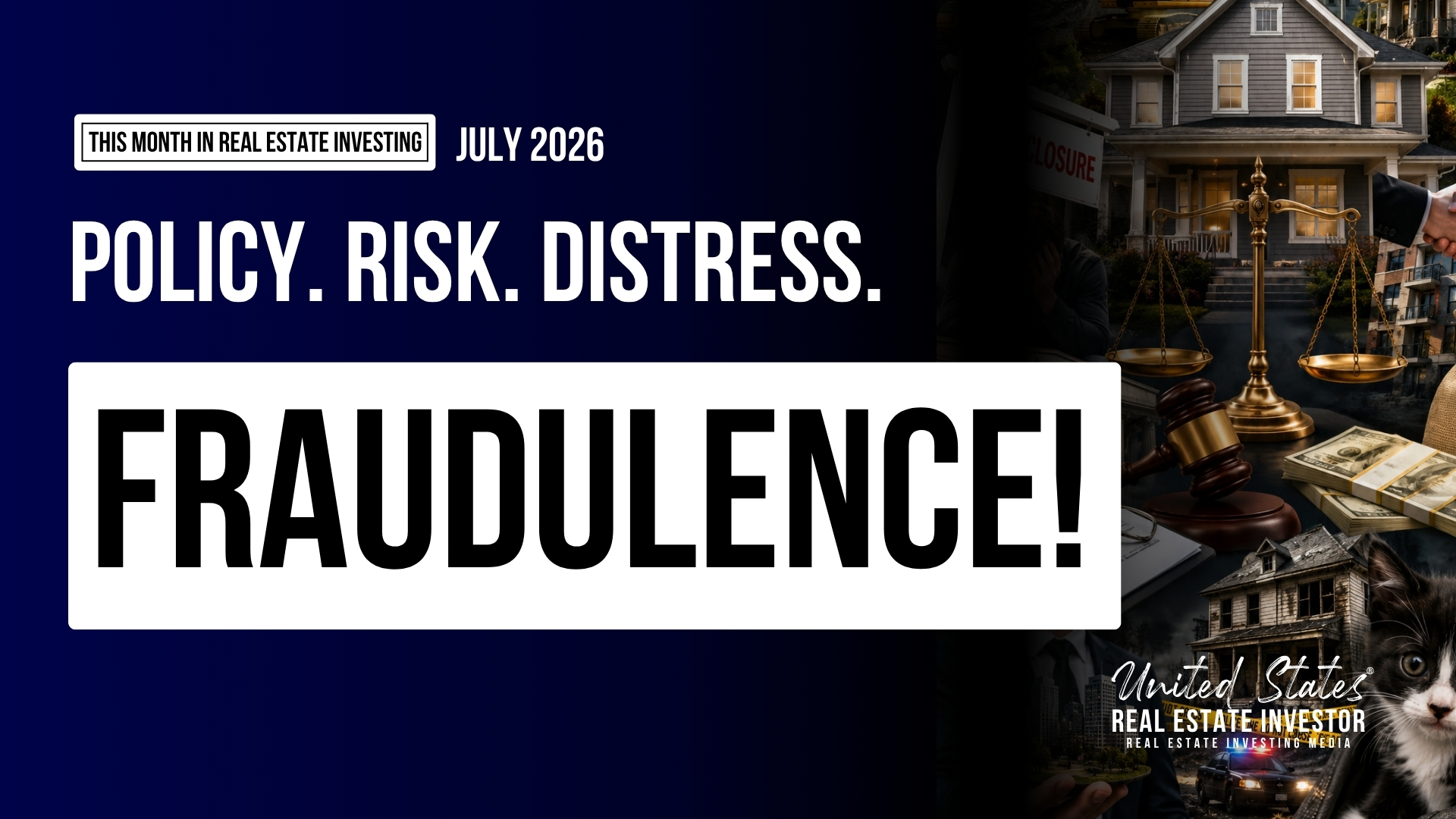
https://www.youtube.com/watch?v=gFYoksg5oZY
United States Real Estate Investor®
This Month In Real Estate Investing
This Month In Real Estate Investing is the monthly United States Real Estate Investor show featuring your favorite REI personalities discussing the month’s news, trends, economics, culture, and much more...
This Month's News Items
• Federal Housing Package Becomes Law
• U.S. Foreclosures Surge 21%
• Mortgage Rates Hit 11-Month High
• Compass And MLS Deals Face Scrutiny
• Home Equity Agreements Face Lawsuits
• Arbor Accused In Multifamily Foreclosure
• Developers Hit With $400 Million Judgment
• Bankruptcies Threaten Commercial Leases
• Foreclosure Buyer Finds Three Bodies
• Bank Robber Uses Kitten As Decoy
July Does Not Knock. It Kicks the Door In.
July 2026 arrives like a warning siren for anyone watching America’s housing and property markets.
Congress rewrites federal housing policy. Foreclosure activity climbs sharply. Mortgage rates squeeze buyers while builders sit on months of unsold inventory.
Private listing networks trigger demands for federal scrutiny.
Homeowners challenge equity agreements in court. Multifamily borrowers accuse a major lender of leading them toward foreclosure.
Commercial tenants use bankruptcy to escape leases. A massive development fraud judgment exposes the danger of trusting glossy promises.
Then, somehow, the month ends with an investor entering a foreclosed home and discovering three bodies inside.
This Month In Real Estate Investing host James A. Brown leads the July conversation through a market defined by four unavoidable forces: policy, distress, fraud and risk.
Congress Suddenly Rewrites the Housing Battlefield
A Sweeping Federal Package Changes Who Gets a Fair Shot
The 21st Century ROAD to Housing Act becomes law on July 11, bringing more than 45 housing provisions into one major bipartisan package. The legislation seeks to reduce regulatory barriers to construction, modernize HUD programs, expand the ability of community banks to finance housing and address concerns about large institutional investors competing against individual homebuyers. (House Financial Services)
This is not a minor technical adjustment hidden inside Washington paperwork. The law has the potential to influence where homes get built, how projects move through approval systems, how local lenders deploy capital and how large buyers compete for single-family inventory.
For smaller investors, the opportunity may come from reduced construction barriers and expanded local financing. For institutional owners, the law creates a new compliance environment that could affect acquisition strategies and ownership structures.
The biggest question is whether the legislation actually increases housing supply fast enough to improve affordability. Laws can authorize programs and remove barriers, but land costs, labor shortages, insurance expenses, local opposition and financing conditions still determine whether builders can deliver homes profitably.
Foreclosure Numbers Flash a 227,548-Property Warning
Distress Rises While Lenders Move Faster
Foreclosure activity rises dramatically during the first half of 2026. ATTOM reports that 227,548 properties receive default notices, scheduled auctions or bank repossessions, a 21% increase from the same period one year earlier. Foreclosure starts rise 18%, while completed bank repossessions climb 33%. (ATTOM)
The increases are particularly sharp in Idaho, Colorado, Georgia, North Carolina and Mississippi. At the same time, the average completed foreclosure spends 563 days in the process, the shortest average timeline since 2013. (ATTOM)
That combination matters. More properties are entering distress, more lenders are completing repossessions and troubled assets are moving through the system faster.
This does not automatically mean America is repeating 2008. ATTOM describes the broader pattern as a return toward more typical foreclosure activity, although the increases also indicate greater financial strain among some homeowners. (ATTOM)
For investors, the danger is rushing toward the headline without understanding the market underneath it. A foreclosure increase can create opportunities, but it can also signal weakening employment, rising ownership expenses, falling neighborhood demand or borrowers stretched beyond their limits.
The smart investor does not simply ask where foreclosures are increasing. That investor asks why they are increasing and whether the surrounding market can support a profitable exit.
Mortgage Rates Tighten the Noose Around Buyers and Builders
Nine Months of New-Home Supply Meets an 11-Month Rate High
New single-family home sales rise slightly in June, but the improvement does not erase the pressure surrounding the market. Sales remain 5.6% below the previous year, while builders carry approximately 9.3 months of available supply. The median new-home price falls 2.7% from one year earlier to $398,300. (Reuters)
Meanwhile, mortgage rates climb to their highest levels in 11 months. Freddie Mac reports an average 30-year rate of 6.58%, while the Mortgage Bankers Association reports 6.69%. (Reuters)
That creates a painful collision.
Buyers need relief. Builders need sales. Lenders need borrowers who can qualify. Investors need numbers that still work after financing costs, taxes, insurance, repairs and vacancies enter the calculation.
Builders carrying large amounts of inventory may become increasingly aggressive with rate buydowns, closing-cost assistance, upgrades and price reductions. Those incentives could make newly constructed homes more competitive with existing properties.
Yet the advertised deal may not always be the best deal. Investors still need to compare the builder’s incentive package with the actual market value, rental demand, resale competition and long-term payment structure.
A temporary rate buydown can make the first years feel comfortable while hiding a payment that becomes much harder to carry later.
America’s Home Listings Risk Splitting Into Two Different Markets
Private Networks Trigger Antitrust and Fair-Housing Alarm Bells
A coalition of consumer, housing, civil-rights and economic organizations asks the Federal Trade Commission and Department of Justice to investigate agreements involving Compass and several multiple listing services. The organizations allege that expanding private listing networks could reduce transparency, weaken competition and limit the homes visible to certain buyers. (HousingWire)
The complaint goes beyond ordinary brokerage competition. The coalition raises fair-housing concerns and warns that restricted listing access could contribute to selective exclusion or digital redlining. Compass does not immediately provide HousingWire with a response to the coalition’s letter. (HousingWire)
Private listings can offer legitimate advantages in certain circumstances. A seller may want privacy, controlled exposure or time to test pricing before entering the broad market.
The problem appears when privacy becomes a system of restricted access.
When major brokerages hold inventory inside proprietary networks, buyers working with smaller companies may never know those properties exist. Sellers may receive less competition. Independent agents may lose access. Investors may find that the supposed market inventory is only part of the true inventory.
The central fight is no longer merely about where listings appear. It is about who controls the doorway to the housing market.
Homeowners Say Equity Agreements Hide a Financial Trap
Products Marketed as Not a Loan Face Serious Legal Challenges
Hometap faces four lawsuits in 2026 from customers who allege that its home-equity investment agreements operate like mortgages and should follow federal and state lending requirements. The plaintiffs claim that contracts presented as not a loan can produce large and difficult-to-predict repayment obligations. (HousingWire)
One lawsuit involves homeowners who allegedly receive approximately $98,000 but could owe between roughly $177,000 and $199,000 based on their home’s value. Another complaint calculates that a projected payoff could become approximately 224% greater than the amount initially received. These figures are allegations contained in the lawsuits, not final judicial findings. (HousingWire)
Hometap disputes the claims and defends the transparency of its product, disclosures and homeowner education. The company maintains that home-equity investments are fundamentally different from traditional mortgage loans. (HousingWire)
The attraction is easy to understand. A homeowner receives cash without adding a traditional monthly payment.
The hidden difficulty is that the true cost depends on future appreciation, contract terms, triggering events and the value of the home when the agreement ends. That makes the product harder to compare with a mortgage, home-equity loan or cash-out refinance.
For investors and homeowners, the lesson is simple but uncomfortable. A financial product does not become inexpensive merely because it avoids the word loan.
A Multifamily Refinance Dream Turns Into a $175 Million Legal War
Bridge Debt Becomes the Center of an Investor Nightmare
The former owners of a 474-unit apartment complex in College Park, Georgia, sue Arbor Realty Trust for $175 million. They allege Arbor places them into a high-interest bridge loan while leading them to expect a later Fannie Mae refinance. According to the lawsuit, the permanent financing does not close, the property enters foreclosure and an Arbor affiliate purchases it at auction for $40 million. (The Real Deal)
Arbor strongly denies the allegations. The company says the property owners mismanage the apartments, fail to complete required repairs and default financially. Arbor maintains that it intends to secure the refinancing but cannot proceed because the borrowers do not satisfy necessary conditions. (The Real Deal)
The dispute represents one of the most dangerous weaknesses in aggressive multifamily investing.
A bridge loan buys time. It does not guarantee the future.
When a property’s entire business plan depends on refinancing, every delay becomes dangerous. Rising rates can destroy proceeds. Repair requirements can prevent approval. Weak occupancy can reduce valuation. Expired rate caps can push debt service beyond the property’s income.
Investors often focus on the planned exit while treating the bridge loan as a temporary inconvenience. July’s story shows why the bridge itself can become the cliff.
A Luxury Development Dream Explodes Into a $400 Million Judgment
Beautiful Renderings Cannot Replace Money, Permits or Proof
A Texas jury orders Frisco entrepreneurs Gopala Krishnan and Sakthivel Gounder to pay more than $400 million after finding them liable for fraud and breach of contract. The dispute involves a proposed 400-acre luxury waterfront development called The District. Promotional materials describe an enormous mixed-use destination, but the plaintiff alleges the project is never genuinely intended to materialize. (The Real Deal)
Energy Commissioning Inc. is reportedly engaged for $21 million in infrastructure work. The jury’s award includes approximately $300 million in exemplary damages. The defendants also previously face an SEC asset freeze tied to a separate alleged $130 million Ponzi scheme. (The Real Deal)
Large development schemes often become believable through repetition. A rendering appears. A project name sounds official. Consultants become involved. Infrastructure plans emerge. International financing gets discussed. Land changes hands. Every new participant makes the project look more legitimate.
Yet none of those things proves that usable capital exists.
Before money, land, services or reputation enter a project, investors need independent confirmation of financing, ownership, entitlements, permits, contracts and the sponsor’s legal history.
A beautiful presentation can show what a project might become. It cannot prove that the sponsor possesses the ability or intention to build it.
Commercial Tenants Enter Bankruptcy and Turn Leases Into Weapons
A Strong Building Can Still Collapse Under a Weak Tenant
U.S. bankruptcy filings rise nearly 12% to 591,850 during the reported 12-month period. Retailers and restaurant operators increasingly use Chapter 11 to reject leases, demand lower rents and close weaker locations. (CRE Daily)
The pressure extends beyond large national chains. CRE Daily also points to significant distress among smaller businesses, while inflation, elevated interest rates and shifting consumer behavior squeeze tenants’ margins. (CRE Daily)
This changes the way commercial property needs to be evaluated.
A tenant with a recognizable name can still become financially fragile. A long lease can still be rejected. Contracted rent can still disappear. A restaurant space can sit vacant for months while the landlord pays taxes, insurance, maintenance and debt service.
Commercial investors sometimes treat the lease as guaranteed income. Bankruptcy law reminds them that the tenant’s ability to perform matters more than the length of the contract.
The property may be physically excellent, but its value can fall quickly when the business occupying it no longer works.
An Investor Buys a Foreclosure Bargain and Walks Into a Horror Story
Three Bodies Wait Behind the Door
An investor purchases a four-bedroom home in Burlington, Connecticut, at a foreclosure auction for $525,000. The property carries an estimated value of approximately $650,000, making the winning bid appear to be a substantial bargain. Because the auction is conducted sight unseen, the investor cannot inspect the interior before bidding. (The Wall Street Journal)
When he finally enters, he discovers three sets of skeletal remains. Authorities identify two as the former co-owner and her son, while the third remains under investigation at the time of publication. The investor asks the court to delay the closing while police complete their work. (The Wall Street Journal)
The story is extreme, but the underlying investment lesson is painfully ordinary.
Foreclosure buyers routinely face unknown repair costs, occupancy problems, vandalism, pests, title complications and personal property left behind. The winning bidder may be buying far more than a discounted structure.
A visible discount is not the same thing as a known profit.
When interior access is impossible, the investor must calculate risk using worst-case assumptions rather than optimistic guesses. That can include major rehabilitation, legal delays, environmental concerns, removal costs and the possibility that the deal cannot close normally.
This property delivers the most unforgettable warning of July: the locked door is part of the investment.
A Stolen Kitten Becomes the World’s Cutest Unwilling Bank-Robbery Accomplice
Magnolia Survives the Strangest Crime Story of the Month
The month’s extra story moves away from property markets and lands in Beltsville, Maryland, where a man allegedly steals a three-month-old tuxedo kitten named Magnolia from a pet store and carries her into a nearby bank. According to CBS Baltimore, he hands the kitten to an employee, writes a demand note and attempts to rob the bank. (CBS News)
The attempted robbery fails. Police take the man into custody, and Magnolia is found unharmed inside the bank manager’s office. The rescue organization caring for her hopes the attention encourages more people to adopt animals needing permanent homes. (CBS News)
It is bizarre, frightening and strangely heartwarming at the same time.
Magnolia does not choose a life of crime. She simply survives one of the worst getaway plans imaginable and walks away as the most lovable figure in the entire July news cycle.
The Market Is Not Asking Investors to Panic. It Is Demanding That They Pay Attention.
July 2026 does not deliver one clear market direction. It delivers competing signals.
Federal policy attempts to expand supply and protect buyers. Foreclosures rise. Builders hold inventory. Mortgage rates stay punishing. Large companies fight over listing access. Alternative equity products face legal scrutiny. Bridge lending becomes the center of a multifamily dispute. Bankrupt tenants challenge property income. Fraud destroys trust. A foreclosure bargain hides an unimaginable discovery.
James A. Brown and the TMIREI panel enter a conversation that reaches far beyond whether prices move up or down.
The larger issue is whether investors understand the contracts, systems, people, and hidden risks behind every opportunity.
July’s lesson is not that investing becomes impossible. It is that easy assumptions become expensive.
United States Real Estate Investor®
Join the live chat!
YouTube
United States Real Estate Investor®
Show Notes
Host: James A. Brown
Visit the Legacy Wealth Collective
Guests: Ryan Riggins
Don’t forget to subscribe for monthly insights that could make a significant impact on your real estate investment strategy.
Connect with us on our socials for more updates and join our community of savvy real estate investors.
Happy investing!
United States Real Estate Investor®
Sponsors


United States Real Estate Investor®
Podcast Guest Opportunity
Interested in being a guest on our shows?
Contact us now for information

https://www.unitedstatesrealestateinvestor.com/this-month-in-real-estate-investing-july-2026-policy-risk-distress-fraudulence/?fsp_sid=56118


Comments
Post a Comment