Cincinnati Empty Towers Win $22M Rescue
Why Do Cincinnati Towers Need Rescue?
Falling bricks, structural decay, and costly safety failures have turned several Cincinnati towers into urgent public hazards.
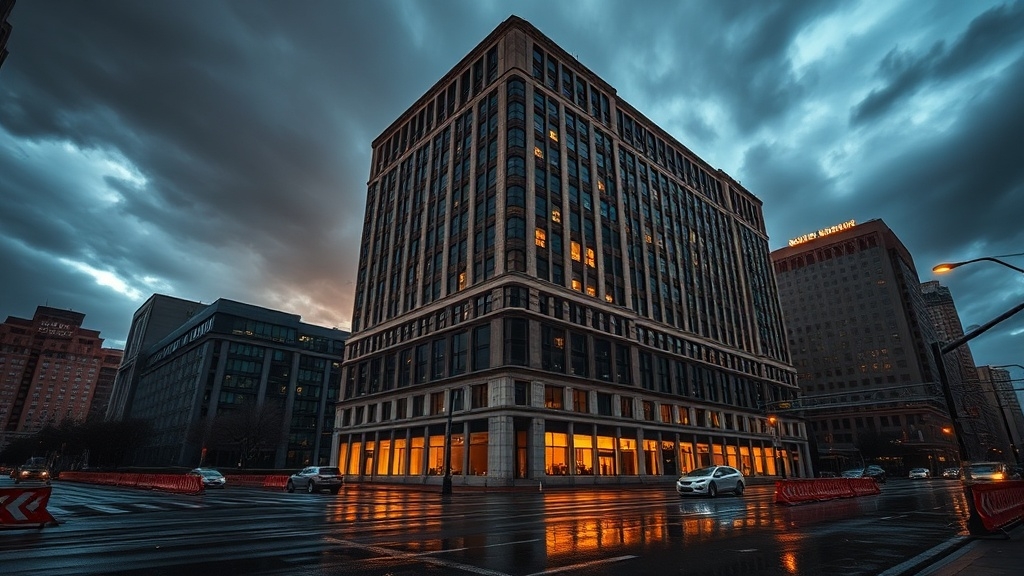
At Carew Tower, loose bricks fell and damaged a vehicle, forcing police to close streets near Fountain Square. Vine Street and parts of 5th Street were shut because of continuing falling debris risks. The tower was purchased in 2022 by Victrix LLC as part of a proposed $175 million adaptive reuse project aimed at saving the landmark.
These incidents show how structural hazards in prominent downtown buildings can quickly disrupt traffic, businesses, and daily movement. Similar crises in nearby cities have been worsened by rising vacancy rates, which undermine the finances needed to maintain aging towers.
Elsewhere, scaffolding and suspended platform failures exposed additional risks during maintenance work. Workers had to be rescued after collapses at the Textile Building and U.S. Bank Tower sites.
At Crosley Tower, emergency procedures highlight operational limits during fire or severe weather events.
Together, these conditions demonstrate why rescue funding is tied not only to preservation, but also to immediate public safety and stabilizing aging infrastructure.
How Did Office Vacancies Drive Conversions?
Mounting office vacancies intensified the financial pressure on downtown towers, pushing owners and developers toward residential conversion as a practical recovery strategy.
Cincinnati office vacancy reached 20.6% in Q3 2025 and averaged 21.0% in Q1 2026 across all classes.
Those levels signaled weakened demand, even as some submarkets remained steadier.
The market dynamics reflected uneven recovery, with positive absorption in 2024 but renewed softness in early 2025.
In other Midwest housing markets, rising distress such as Chicago’s foreclosure surge has underscored how broader economic pressure can reshape urban real estate decisions.
Tenant Migration Accelerated Repositioning
Tenant migration into newer or better-positioned space left older downtown buildings with fewer leasing prospects.
That imbalance made long-term office hold strategies harder to justify, especially when asking rents rose only modestly to $20.81 per square foot.
More than 9% of regional office inventory entered conversion pipelines, placing Cincinnati among national leaders in office-to-residential activity by late 2024.
How Are Cincinnati Tower Conversions Funded?
Conversion financing in Cincinnati relies on a layered capital stack. It typically combines historic tax credits, public incentives, private equity, construction debt, and targeted remediation grants.
Historic tax credits are central to many projects. Ohio preservation credits can cover up to 25 percent of qualified rehabilitation costs, capped at $5 million per award.
Federal incentives added $28.3 million to Carew Tower. TMUD credits supplied another $4.25 million.
Property tax abatements can reduce improvement taxes for 30 years. TIF districts can redirect future tax growth into project budgets.
Private equity often covers 30 to 40 percent of total costs. Brownfield grants can fund asbestos cleanup, demolition, and roof work.
Public support often helps close financing gaps. Brownfield grants also reduce environmental risk on older downtown properties.
Carew Tower received $6.439 million for remediation. Specialized loans can help close remaining gaps on difficult reuse projects.
Which Cincinnati Towers Are Becoming Apartments?
Across downtown Cincinnati, several prominent office and commercial towers are being repositioned as market-rate apartment buildings. Owners are pursuing adaptive reuse at scale.
Union Central Tower at 9 W. Fourth Street, a 31-story landmark also known as Fourth & Vine or Central Trust Tower, became Sky Central Apartments in 2025. The $99 million project created 281 units while preserving historic facades and leveraging strong transit access.
Major Projects Advancing
Carew Tower, the 49-story skyscraper acquired by Victrix Investments in 2022, is slated for 375 apartments on floors four through 49. Retail will remain below.
Construction is scheduled from 2025 through 2029.
The former Macy's headquarters at 7 West 7th has already opened leasing for 341 market-rate apartments. That conversion established another large residential tower within Cincinnati's commercial core.
How Will Conversions Change Downtown Housing?
These tower redevelopments are set to materially expand downtown Cincinnati's housing inventory.
The market is shifting from a limited office-centered core toward a denser residential district.
More than 2,300 apartments are in the regional conversion pipeline, with major projects adding hundreds of units.
That surge is temporarily lifting vacancy, but it also broadens choices and resets pricing pressure.
- Carew Tower adds 385 units through a $162 million overhaul
- 7 West 7th delivered 341 apartments in the former Macy's headquarters
- Mercantile Building brings 171 units with urban amenities
- Mixed-use plans add retail, galleries, and cultural programming
By 2027, conversions are expected to deliver more than 1,000 additional homes downtown.
The shift reduces obsolete office inventory and supports a lifestyle-oriented core shaped by residential demand, hybrid work, and adaptive reuse.
Assessment
Cincinnati’s $22 million rescue marks a critical attempt to stabilize distressed downtown towers and counter deep office market weakness.
By channeling public support into apartment conversions, the city is backing a faster reset for obsolete buildings with persistent vacancies.
The targeted projects could add badly needed housing while reducing the drag of empty high-rise space.
The outcome will shape downtown property values, tax revenue, and confidence in Cincinnati’s urban core.
https://www.unitedstatesrealestateinvestor.com/cincinnati-empty-towers-win-22m-rescue/?fsp_sid=51772


Comments
Post a Comment