Arizona Water Policy Threatens New Development
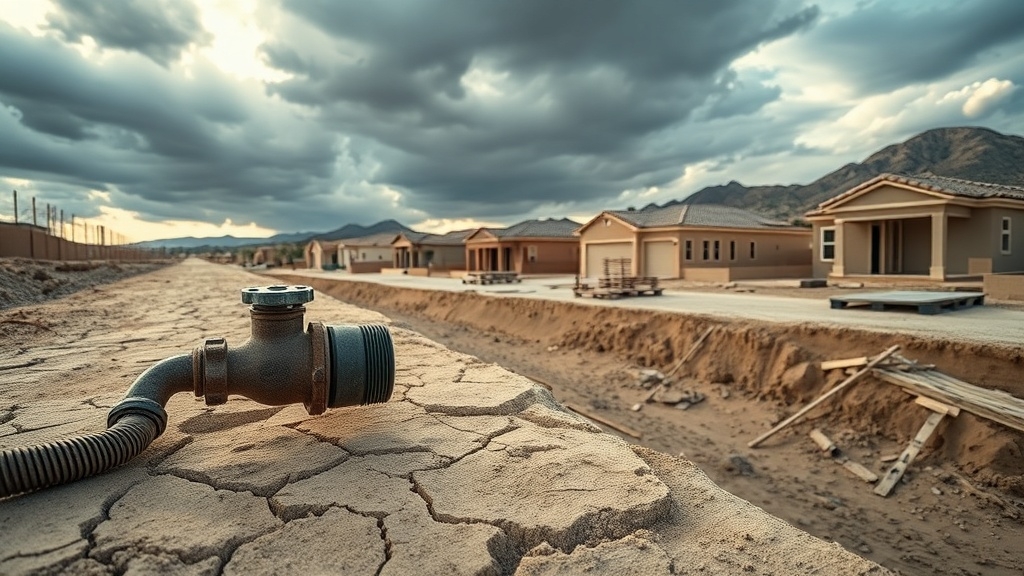
What Arizona Water Policy Is Blocking Phoenix Approvals?
How Arizona measures future groundwater availability has become the immediate barrier to final plat and building approvals across parts of the Phoenix metro.
2023 Model Update Disrupts Approvals
The updated model showed a shortage trajectory, forcing officials to stop approvals tied only to local groundwater. This bottleneck has coincided with a 41% drop in Phoenix permits, tightening the supply outlook even as demand remains elevated.
Pre-May 31, 2023 analyses were rejected for finals.
Officials also began requiring subtraction of water already promised, tightening the numbers further.
That intensified infrastructure constraints in places like Buckeye and Queen Creek.
2024 Policy Shift Triggers Legal and Legislative Turmoil
ADWR’s AMA Wide Unmet Demand Rule framework, introduced without formal rulemaking, stalled metro applications.
It also raised questions about municipal capacity.
The Goldwater Institute sued in Maricopa County Superior Court.
Meanwhile, SB 1288 would revive older analyses with a 15% cut.
Credit programs also began in Buckeye.
Separately, the governor’s FY 2027 budget proposes a $30 million one-time deposit into the newly created Colorado River Protection Fund.
What Is the Assured Water Supply Program?
Within Arizona’s Active Management Areas (AMAs), a subdivision plat often can’t move forward without the Assured Water Supply program.
The Arizona Department of Water Resources (ADWR) runs this program across Arizona’s five AMAs under the 1980 Groundwater Management Act.
As recent market shifts tied to FEMA flood maps show, official risk designations can quickly reshape real estate outcomes and buyer behavior.
Approval choke point
Inside AMAs, developers must obtain an ADWR determination before plat recordation and sales.
The Arizona Department of Real Estate may withhold a public report if the determination isn’t in place.
Eligibility criteria and application process
To qualify, an applicant must document a 100-year water supply that is physical, continuous, and legal.
The water must also be of acceptable quality, and the applicant must show financing for delivery, storage, and treatment, or secure a commitment from a designated provider.
| Test | ADWR review | Outcome |
|---|---|---|
| Supply | 100-year volume | Certificate |
| Rights | Contracts | Approval |
| Systems | Capacity | Service |
How ADWR’s “Unmet Demand” Changed Arizona Water Policy?
After the Assured Water Supply program became the gatekeeper for subdivision plats, ADWR tightened that gate with an AMA-wide “unmet demand” approach in the Phoenix AMA.
Unmet Demand Becomes the Test
A revised Phoenix AMA groundwater model indicated basinwide overallocation.
This echoed the 2019 Pinal unmet demand disclosure and the 2021 Pinal determinations.
ADWR applied the standard without formal rulemaking or new legislative authorization.
This intensified disputes over model transparency.
Housing Slowdown and Rural Impacts
Developers in Queen Creek and Buckeye reported stalled Certificates of Assured Water Supply.
That effectively stopped subdivision sales outside municipal DAWS service.
Litigation from builders and policy groups alleges the approach exceeds statutory authority.
They also argue it disrupts long-term planning.
Will HB2026 Loosen Arizona Water Policy for Builders?
Why HB2026 has become a flashpoint in Arizona development turns on whether it changes the Assured Water Supply gatekeeping that controls most new subdivisions in Active Management Areas.
The bill does not remove the 100-year certificate requirement, but it rewires how designations are documented.
Disruption to Assured Water Supply Reviews
Demand and Source Limits
HB2026 requires applicants to show reduced water demand.
It also requires reporting projected average annual replenishment obligations.
The bill limits ADWR review to proposed sources dedicated to continuous availability for the designated supply.
Builder Exposure and Market Impacts
Single-family rental subdivisions would need certificates like for-sale projects, removing a long used exemption.
That parity may raise construction costs for rental builders while improving buyer confidence.
It could also clarify market impacts and financing.
Could Lawsuits Rewrite Arizona Water Policy in 2026?
HB2026 put the Assured Water Supply process back in the legislative spotlight.
But the more immediate disruption is coming from the courts.
Litigation Raises 2026 Risk
In January 2025, the Goldwater Institute sued on behalf of the Home Builders Association of Arizona.
Judge Scott Blaney denied ADWR’s motion to dismiss, sending the case toward trial and possible appeals.
Core Arguments
Plaintiffs say ADWR’s November 2024 unmet demand framework is not in statute.
They argue it was imposed without rulemaking or legislative approval.
ADWR argues updated groundwater modeling is authorized.
The agency says it is necessary to protect existing supplies.
Moratorium Fallout
The policy paused certificates for parts of Queen Creek and Buckeye.
That pause intensified affordability strain.
Intervenors including Salt River Project and Chandler show stakeholder influence.
The appeal timeline could push uncertainty into 2026.
Assessment
Arizona’s tightening groundwater accounting has stalled subdivisions in parts of the Phoenix active-management area.
By treating groundwater pumping as unmet demand, ADWR has raised the bar for Assured Water Supply certificates and shifted risk to builders and cities.
HB2026 could provide flexibility, but it does not add new water or resolve aquifer declines.
Litigation over modeling, authority, and reliance interests is expected to intensify.
By 2026, court rulings may reshape approval pathways and financing assumptions.
https://www.unitedstatesrealestateinvestor.com/arizona-water-policy-threatens-new-development/?fsp_sid=35143


Comments
Post a Comment